
The Modern Practice Playbook: 12 Practical Ideas for Doctors Who Want a Stronger, Calmer Practice
Medicine has always been about people, but running a practice today also means managing visibility, communication, scheduling, privacy and team morale. Few doctors were trained for any of that, and most would rather spend their energy on patients.
This guide breaks the business side of medicine into twelve practical topics. Each one stands alone, so read it start to finish or jump to what matters most to you. It is written from general experience and common sense, with no borrowed statistics, so every idea here is something you can test in your own practice.
1. Think of Your Practice as a Journey, Not a Building
Patients do not experience your practice only inside the exam room. Their experience begins when they first wonder where to get help, and it continues long after they leave.
A simple way to see it is in five stages:
- Discovery: the patient looks for help.
- Contact: they call, message or fill in a form.
- Visit: they meet you and your team.
- Follow-up: they receive results, instructions and check-ins.
- Relationship: they return, or recommend you to someone else.
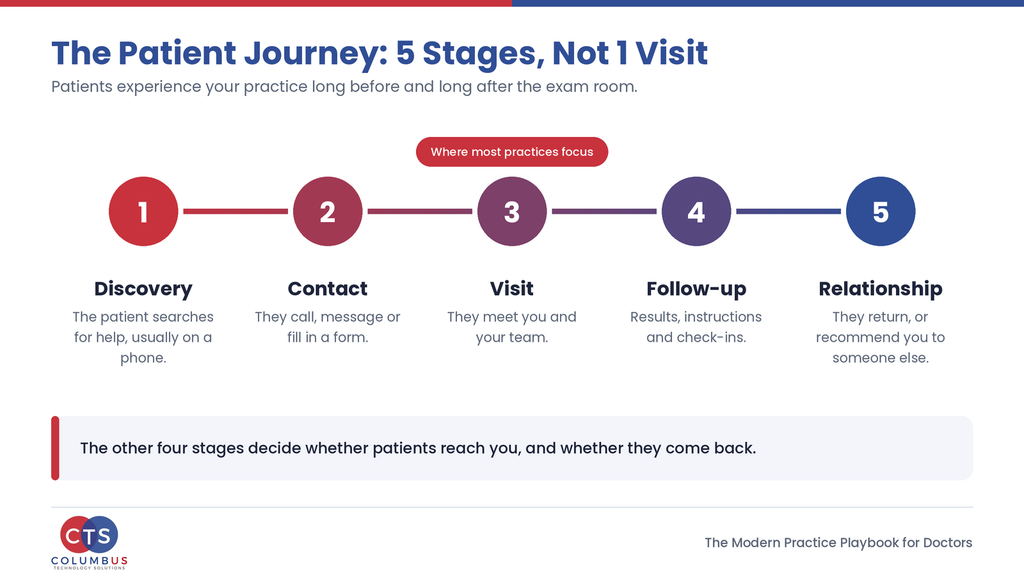
Most practices focus heavily on the third stage. The other four decide whether patients reach you and whether they come back. Walk through each stage as if you were a new patient and note where you would feel confused or ignored.
2. Make Yourself Easy to Find
Before a patient can trust you, they have to find you. For most people, that means an online search on a phone.
Practical steps:
- Claim and complete your online business listings, including hours, address, phone number, specialty and services.
- Keep every detail identical across your website, listings and social profiles. Small mismatches confuse both patients and search engines.
- Add clear photos of your building, entrance and parking so patients know what to expect.
- Write your service descriptions in the words patients use, not only clinical terms. A patient may search for “knee pain” before “osteoarthritis.”
Treat your listing like a front door. If the sign is faded, people may walk past.
3. Build a Website That Answers Questions
A good practice website is not a brochure. It is a helpful front-desk assistant that works at midnight.
A strong site usually includes:
- A clear homepage: who you help, where you are and how to book, visible in a few seconds.
- Doctor profiles: your training, areas of interest and a short, warm personal note. Patients choose people, not logos.
- Service pages: one page per major condition or procedure, written in plain language.
- Practical information: insurance questions, what to bring, parking and accessibility.
- A simple contact method: a short form that takes under a minute, plus a visible phone number.
- Mobile-friendly design: most patients will see it on a phone.
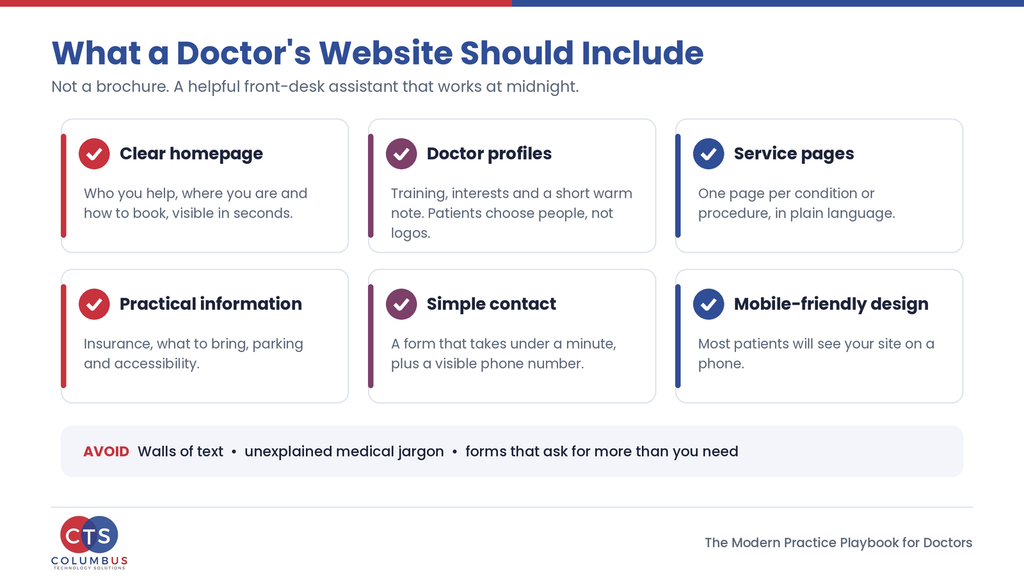
Avoid walls of text, unexplained medical jargon and forms that ask for more than you need.
4. Treat the First Reply as Part of the Care
When a patient reaches out, they are often worried. How quickly and kindly you respond sets the tone for the whole relationship.
Small changes that help:
- Send an automatic acknowledgment as soon as a request arrives, so the patient knows it was received.
- Tell them what will happen next and roughly when.
- Make sure someone owns after-hours requests so they are not forgotten until midday.
- Keep a short set of friendly reply templates, and personalize the opening line.
Ask your manager to track how long it takes your practice to reply to new requests. You cannot improve what nobody measures.
5. Earn Reviews the Honest Way
Patients often read what other patients say before they book. You cannot control opinions, but you can make it easy for satisfied patients to share them and show that you listen to the rest.
Good habits:
- Ask for feedback at the end of a positive visit, in person or in a follow-up message.
- Never offer rewards in exchange for reviews or ask for only positive ones, since this can breach platform rules.
- Reply to every review, thanking those who praise you and responding calmly to those who criticize.
- Never confirm that a reviewer was a patient, and never discuss their care in public. Protecting privacy comes first, even when you disagree.
- Use criticism as free consulting. If three people mention long waits, you have found a real problem.
A calm, professional reply to a harsh review often impresses future patients more than a glowing one.
6. Teach, Don’t Sell
The most trusted form of promotion in medicine is education. When you help people understand their health, you demonstrate expertise without saying “choose me.”
Ideas for useful content:
- Short articles explaining common conditions, symptoms worth taking seriously and what to expect from treatment.
- Seasonal reminders, such as preparing for allergy season or staying active in winter.
- Plain-language explanations of procedures, including recovery and common questions.
- Myth-busting posts that gently correct common misunderstandings.
- Short videos of you answering one frequently asked question.
Keep it ethical:
- Avoid fear-based language and exaggerated claims.
- Never promise results.
- Make clear that general information does not replace a personal medical consultation.
7. Respect the Patient’s Time
Long waits are one of the most common frustrations in healthcare, and most can be reduced with small adjustments.
Ideas to test:
- Review your schedule for appointment lengths that do not match reality. If a visit type regularly runs long, schedule it that way.
- Build short buffer slots into busy sessions so one delay does not cascade through the day.
- Send reminders by text or email, with an easy way to confirm or reschedule.
- Fill cancellations through a short waiting list.
- If you are running late, tell patients early. An honest update feels much better than a silent wait.
- Collect forms digitally before the visit so the first minutes are about care, not paperwork.
8. Offer Choices in How Patients Communicate
Not every patient wants to talk by phone. Some prefer messages because of work, anxiety, hearing difficulties or privacy. Others will always prefer a voice.
Consider offering:
- Phone for those who want it.
- Secure messaging for questions that do not need a call.
- Text reminders for appointments, without any medical details.
- Online booking for those who want to schedule at any hour.
- Telehealth where clinically appropriate, such as follow-ups, medication reviews and routine check-ins.
Offering options does not mean doing more work. It means letting patients reach you in the way they will actually use.
9. Protect Privacy in Everything You Do
Privacy is not an obstacle to communication. It is a reason patients trust you in the first place.
Habits that protect patients and your practice:
- Keep reminders and general messages free of diagnoses, test results and treatment details.
- Use tools and vendors that are appropriate for healthcare, and ask whether they will sign the agreements your local regulations require.
- Get and record consent before contacting patients by text or email.
- Limit who on your team can see what, based on their role.
- Review website forms, analytics and advertising tools with your compliance lead, since some tracking tools can capture more than you intend.
- Train staff regularly with real examples, not only policy documents.
Rules differ by country and region, so confirm requirements with a qualified adviser. Nothing in this article is legal advice.
10. Care for Your Team and Yourself
A tired, stretched team cannot deliver warm, careful service. Burnout is a workflow problem as much as a personal one, and workflow problems can often be fixed.
Practical ideas:
- Ask staff which three tasks waste the most time. Fix those first.
- Reduce duplicate data entry wherever you can.
- Create simple checklists for repeated tasks, such as opening the clinic, preparing for procedures and closing the day.
- Share the load. Let the right person handle each task so doctors do not spend time on work that others can do well.
- Protect breaks. A short real pause often prevents mistakes later.
- Hold a brief weekly huddle to share what went well, what did not and what to change.
- Thank your team specifically and often.
A calm practice feels calmer to patients too.
11. Build Relationships After the Visit
Many practices only contact patients when there is a problem or a bill. A little proactive care builds loyalty and often improves health outcomes.
Ideas:
- A short check-in after a new treatment or procedure.
- Reminders for routine screenings and preventive visits when they are due.
- Clear written instructions after each visit, including when to call and when to seek urgent care.
- A brief “how did we do?” message after a visit.
- A warm welcome-back message to patients who have not visited for a long time.
Patients who feel known and remembered tend to stay, and they tend to speak well of you to friends and family.
12. Measure a Few Things, Not Everything
You do not need a complicated dashboard. A small set of numbers, reviewed regularly, will show you where to improve.
Useful measures:
- How many new patient requests arrive each week.
- How long it takes to reply to them.
- How many requests become booked visits.
- How many booked visits are completed, and how many are missed.
- Where new patients say they heard about you.
- What patients say in reviews and feedback.
Review them monthly with your team. Celebrate improvements and choose one thing to fix next. Whenever you compare numbers, compare them to your own past results rather than to someone else’s, since every practice is different.
Common Mistakes to Avoid
- Doing everything at once. Change one thing at a time so you can see what works.
- Ignoring the front desk. The first human voice a patient meets matters enormously.
- Using jargon. If a patient cannot understand your website, they may go elsewhere.
- Overpromising. Honest, modest claims protect both patients and your reputation.
- Forgetting privacy. One careless message can undo years of trust.
- Stopping after a burst of effort. Steady, small habits beat occasional big pushes.
A 90-Day Starting Plan

Month 1: Foundations
- Check that every online listing is complete and consistent.
- Review your website for clarity on a phone.
- Start measuring how quickly requests are answered.
Month 2: Experience
- Add an automatic acknowledgment for new requests.
- Introduce appointment reminders and digital forms.
- Reply to every review, using a calm, privacy-safe approach.
Month 3: Growth
- Publish two or three simple educational articles.
- Begin follow-up messages after visits.
- Hold a team review to decide what to keep, change or drop.
Frequently Asked Questions
Do I need to be on social media?
Not necessarily. Choose one or two places where your patients actually spend time and share useful information consistently, rather than posting everywhere.
Is it ethical for a doctor to promote a practice?
Yes, when the focus is on education, accuracy and transparency. Helping patients find the right care is a service. Pressure, exaggeration and unsupported promises are not acceptable.
How much time should this take?
Most of these ideas can be handled by one organized team member for a few hours a week. Your role is to set the standards and review progress.
What should I do first?
Check how easy it is to find you, and how long it takes to answer a new request. Those two answers usually show the best starting point.
How Columbus Technology Solutions Can Help
At Columbus Technology Solutions, we help medical practices make sense of the patient journey, from the first search to the long-term relationship. We support practices with clearer websites, smoother communication, thoughtful measurement and an ethical, privacy-aware approach, so doctors can focus on what they do best.
If you would like a practical, no-pressure review of how patients experience your practice today, our team would be glad to talk.
Columbus Technology Solutions. Your Partners in Better Care.
This article is written for general information only. It is not medical, legal or compliance advice. Requirements vary by location, so consult a qualified professional before making changes that involve patient data.